
Dear reader,
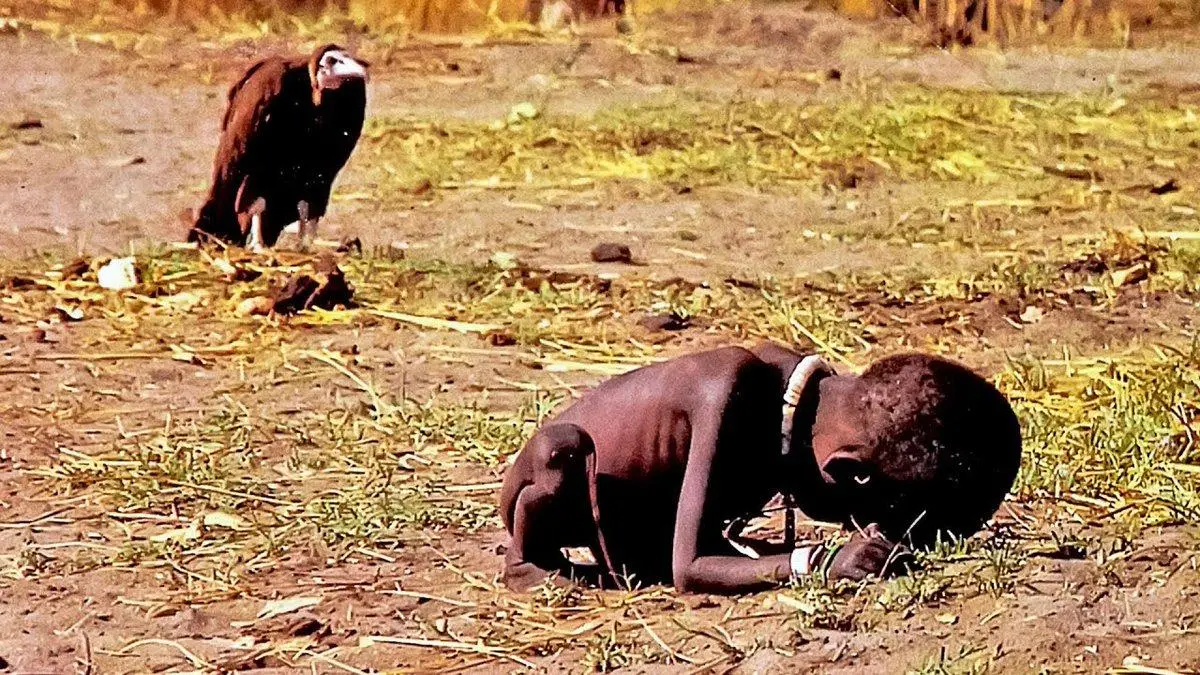
There is an old, almost ritual question that journalism schools across the world have been asking for a generation now, and it is one I have answered in my head a thousand times. The question is built around a single photograph. You know the one. A frail child, slumped on the cracked Sudanese earth in March 1993, and behind the child a hooded vulture, patient and focussed. The picture appeared in The New York Times on March 26, 1993. Looking at it then, many assumed the child was a girl. It was not until 2011, when reporters from the Spanish daily El Mundo went looking for the family, that the world learned the child was a boy named Kong Nyong, and that he had survived that day, by walking to the UN feeding centre at Ayod, only to die years later, in 2007, of fever. The picture was made by Kevin Carter, a 32-year-old from Johannesburg who belonged to the small, hard-drinking, hard-working group of photojournalists known as the Bang-Bang Club. It won the Pulitzer Prize for Feature Photography in 1994. Four months later, Carter was dead.
The question journalism teachers like to put before their students is this: what should the news photographer do? Save the child from the vulture or click the photograph?
My answer is unfashionable, and I suspect most working photographers will agree. Click the damn photograph. A published image can mobilise a million strangers; a single act of rescue can save one. That is the cold, unsentimental arithmetic, and almost every honest photojournalist I have spoken to over the years has accepted it without flourish. It is also, in a deeper sense, a Marxian arithmetic—the recognition that an individual gesture of charity, however brave, cannot substitute for the systemic intervention that a wide public conscience can compel. Carter knew this. The day his picture ran, the New YorkTimes was flooded with letters and calls. Donations poured into aid agencies. The image was reprinted on fundraising posters from Toronto to Tokyo. The photograph did what war correspondents and relief agencies could not do—it made the famine visible.
The history of news photography is full of such moments. The form itself was born in war and reluctance. The first systematic photographs of a battlefield were made by the Englishman Roger Fenton during the Crimean War in 1855, working out of a horse-drawn wine merchant’s wagon. He could not photograph the dead—Victorian sensibilities had to be protected. So he came home with around 350 plates, almost none of them showing the carnage he had walked through. A few years later, in the American Civil War, Mathew Brady’s studio dispensed with that delicacy. Brady’s exhibition of bodies at Antietam, in 1862, made one New York reviewer write that the photographer had laid corpses on the city’s doorstep. The shock was new. The convention had been broken. After that, no war could be sold quite the same way to a literate public again.
This was the slow, often unglamorous beginning of a craft that would, by the middle of the 20th century, become the conscience of the modern world. The Hungarian Endre Friedmann, who renamed himself Robert Capa to seem more saleable to American editors, made the philosophy of the trade as plain as anyone has: if your pictures aren’t good enough, you’re not close enough. Capa was close enough on Omaha Beach on D-Day, when most of his Normandy negatives were destroyed in a darkroom accident, leaving us only the famous eleven blurred frames. He was close enough on the road to Thai Binh in Indochina on May 25, 1954, when he stepped on a landmine and died at forty, with a Nikon S and a Contax II still on him. His professional and personal partner Gerda Taro had been killed 17 years earlier, at 26, on the Brunete front in the Spanish Civil War. They invented the modern war photographer between them, and the form (or art?) has been paying the price in blood ever since.
We tend to remember the canonical names—Capa, Eddie Adams who in 1968 caught a police chief executing a Viet Cong suspect with a single pistol shot to the temple, Nick Ut who in 1972 caught a naked nine-year-old girl running burning down a road from a napalm strike (despite the recent row over the photo’s real authorship)—and we forget the wider, mostly anonymous tribe whose work is the actual pulse of the form. In our part of the world it is impossible to talk about photojournalism without bowing to Sunil Janah, who, encouraged by CPI general secretary P.C. Joshi, travelled through the Bengal famine of 1943 and made devastating, intimate photographs. There is Homai Vyarawalla, India’s first woman press photographer, working through Independence and Partition in a sari and a Rolleiflex. There is Kishor Parekh, whose images of the Bangladesh war of 1971 still set the bar. There is T.S. Satyan, the Mysore boy whose long, kind, careful career documented the Indian small town as a moral place. And there is Raghubir Singh, who insisted, against the dominant black-and-white orthodoxy of Magnum, that India had to be photographed in colour because the country itself was colour.
And there is the everyday discipline of the Kashmir corps—Dar Yasin, Mukhtar Khan, and Channi Anand of the Associated Press, who in 2020 won the Pulitzer for feature photography for their coverage of the post-Article 370 lockdown, working through a communications blackout by hiding cameras in vegetable bags and persuading air travellers to courier their photo files out to Delhi; The Hindu’s Nissar Ahmad, who covered three decades of the Valley’s turmoil and beauty for the paper before he died in Srinagar in June 2024, working until his cancer would not let him hold the camera; and Victor George, the chief photographer of Malayala Manorama, who was buried alive by a landslide in Idukki in July 2001 while photographing his beloved monsoon for a book that was published, finally, after his death.
None of them got rich. Most worked for embarrassingly low newspaper salaries.
The tribe is not, in any country, a tribe of celebrities. The men and women who fill the picture desks of our newspapers and magazines tend to be modest, often shy, frequently underpaid, almost always tired. They get to the riot before the reporter and stay after the reporter has gone to file. They negotiate with policemen, mourners, doctors, gangsters, and grieving mothers in the same 15 minutes. They carry equipment that costs more than they earn in two years. In an Indian newsroom of the 1990s, a staff photographer might spend a morning at a court hearing in connection with a custodial death case, an afternoon at a bypoll, and an evening at a chemical leak in an industrial belt. The photograph that runs the next day is captioned with three words and a name. That is the deal. The work is for the world, not the byline.
Risk is the constant, and the camera is what marks you. The visual journalist is the easiest figure on a battlefield to recognise—the long lens, the heavy vest, the body angled forward toward whatever everyone else is running from. By the end of January 2024, of the 83 journalists and media workers the Committee to Protect Journalists had recorded killed since October 7, 2023, at least 22 were photographers, videographers or camera operators—well over a quarter of the toll. The roll has only lengthened. The Reuters cameraman Hussam al-Masri and the AP freelancer Mariam Abu Daqqa were both killed in the August 25, 2025 Israeli “double-tap” strike on Nasser Hospital in Khan Younis, which a Reuters investigation later concluded had targeted a camera that the agency had positioned at the site for months, with the Israeli military’s full knowledge, to provide a live news feed.
The financial woes of the trade is the other half of the story, and the more insidious half. The picture desk is the first thing modern proprietors close. Wire services have shed staff. Magazines that once kept fifteen photographers on retainer now keep one, or none. Local newspapers across India, the US, Britain, and most of Europe have laid off their photographers and asked reporters to take pictures with their phones. The freelancer who covers a war zone today often pays for her own helmet, her own insurance, her own evacuation. AI-generated images are beginning to crowd legitimate photojournalism out of search results, and the fight against fabrication has become a daily editorial chore. The vanishing of the staff photographer is, in this sense, of a piece with the vanishing of the trade unionised industrial worker—a silent, methodical victory of capital over labour, termed efficiency.
Carter’s death is best understood inside this story rather than apart from it. Three months after the Pulitzer ceremony at Columbia, on July 27, 1994, he drove his red Nissan pickup to a spot near the Field and Study Centre at Parkmore in Johannesburg, where he had played as a boy. He ran a hose from the exhaust pipe through the window. He left a note.
“I’m really, really sorry. The pain of life overrides the joy to the point that joy does not exist. …depressed … without phone … money for rent … money for child support … money for debts … money!!! … I am haunted by the vivid memories of killings & corpses & anger & pain … of starving or wounded children, of trigger-happy madmen, often police, of killer executioners …”
He wanted to join Ken if he was that lucky—Ken Oosterbroek, his closest friend, killed at Tokoza township a few months earlier while photographing the dying days of apartheid violence. He was 33. The logic that had served him in Sudan—that the picture was worth more than the rescue—gave him no comfort at all when his own life was on the table. That, too, is part of the bargain photojournalism makes with the people it sends into the field.
What is being lost, as the trade thins out, is a way of paying attention. A staff photographer in a small town is, among other things, a neighbour with a camera. He knows the road where the protest will form, the lane where the moneylender lives, the hospital corridor where the patient’s family will weep. He sees the place as a place rather than as a backdrop. When the picture desks close and the freelancer is sent in for the day, that local memory goes with them. Famine becomes generic. Grief becomes interchangeable. The image flattens out into stock. We have begun to see the consequences in the look of the news itself—in the stylistic sameness of the photographs we see from very different places, in the growing distance between the people in the picture and the people who made it.
And yet, against every prediction, the work continues. In Gaza, in Khartoum, in the Donbas, in Manipur and Bastar and Beirut, men and women are still getting up before dawn, charging batteries, checking the SD card, leaving home. They go out for salaries that have not kept pace with the rent. Few of them have staff insurance. Most know the death tolls. The reason any of this still happens is straightforward: someone has to put the famine on the front page or at least on X, or the famine ends up nowhere. The alternative is a public sphere run on rumour and on retouched press releases—which, increasingly, is what we have anyway. The job is, in the end, performed for a public the photographer will never meet. That is why the trade, for all its bruises, remains one of the more honestly democratic forms of labour we have invented. It works for the many, not for the few.
Raghu Rai, who died in Delhi on April 26, at the age of 83, belonged squarely to that tribe. He had begun by photographing a baby donkey in a north Indian village in the mid 1960s—a picture his elder brother S. Paul sent on to The Times of London, which ran it. He went on to make the photographs that the rest of us have lived inside without quite realising it. Frontline has just published a tribute to him, written by Rahaab Allana, and I recommend you read it. It is one tradition’s homage to another—the long-form magazine bowing to the long-form photograph. Both forms were born in the nineteenth century. Both have spent the last decade being declared dead by people who do not read either. They are, against the odds, still here. So are the men and women who keep them alive, click by click, line by line. We owe them a great deal more than we have so far paid.
Wishing you a lovely week ahead and requesting you to write back, as usual, with your memories around news-photography, and your favoruite lensperson from the country or abroad,
Jinoy Jose P.
Digital Editor,Frontline






Leave a Reply