
In the latest episode of Frontline Conversations, Suhas Palshikar, political scientist and retired professor from Savitribai Phule Pune University, Pune, analyses the growing controversy around the delimitation debate in India, the recent defeat of a Constitution Amendment Bill linked to women’s reservation, and the larger political implications for federalism, representation, and democratic consensus. Drawing on historical context, constitutional provisions, and political developments, he explains why delimitation is emerging as a defining issue for India’s politics over the next decade.
The conversation further explores key questions around population-based representation, the imbalance between States, and the need to reconcile democratic principles with federal realities. Palshikar also reflects on the dangers of politicising and “weaponising” issues like women’s reservation, and how such strategies could increase divisions within Indian democracy.
Edited excerpts:
How do you see the larger picture of these Constitutional Amendment Bills that were defeated last week, and how do you think things will proceed from here?
These were Constitution Amendment Bills. They were very ambitious in their scope, and there was a kind of abruptness to the way they were introduced—no prior consultation, and I am not sure there was adequate consultation even within the ruling coalition itself. These Bills touched upon very sensitive issues, as you rightly pointed out, issues that are going to be at the centre of India’s politics in the coming decade. They could have been handled more carefully so that they did not become explosive. Unfortunately, the government chose to handle them in a ham-handed manner.
As you have pointed out, not even alliance partners were properly consulted. India has a long tradition of consensus-building before bringing any such important Bill to Parliament. This time, that tradition has been completely set aside—the Bill was bulldozed through the House. How is this going to impact the long tradition of consensus-building in key constitutional and parliamentary matters?
There are two things to consider. One is that, even otherwise, over the last decade or so, we have seen the politics of consensus and compromise being largely rejected by the ruling party, replaced by a bare politics of majority—and therefore the politics of dominance by the majority party. The second point concerns constitutional amendments. We know there have been many amendments so far, but if you look at the critical ones, they have always represented a broader consensus.
In fact, the process of amendment is designed with that expectation built in: a two-thirds majority of those present and voting, a clear majority of the total strength of the House in both Houses separately, and, in the case of more important federal-related amendments, approval by half the state legislatures. Anyone who reads Article 368 of the Constitution can see that its makers expected amendments to rest on the foundation of consensus.
This process has been entirely set aside, not just now but over the entire last decade. I want to ask you about the strong opposition from southern parties—not from Chandrababu Naidu or Jagan Mohan Reddy, but the major concern from other southern states. Beyond Karnataka, the BJP has repeatedly failed to gain power in these states. Is the BJP trying to impose a Hindi-heartland view on all other States—East, West, and of course the South? How do you see this?
Yes, the BJP is still weak in Tamil Nadu, Kerala, Andhra Pradesh, and Telangana. But I do not think the BJP’s concern is limited to electoral dominance. The larger question is whether the imagination of what India is should be defined by perceptions dominant in certain parts of the country — the Hindi heartland. And that imagination excludes not just the South. That is why I do not think this is simply a South-North question. It also excludes the Northeast and eastern States like Odisha and West Bengal. In a sense, a small part of the country is being taken as the measure of what we as Indians are—how our culture and our politics should be shaped. That is the larger question; it goes beyond merely the BJP’s electoral calculations.
I want to ask about this further, because as you said, this is not just about North versus South. Punjab’s representation would also have been reduced under the proposed delimitation, as would West Bengal’s. How will the BJP’s singular conception of India damage our federal system and the position of the federal States?
This Bill—and, more importantly, the manner in which it was brought forward—does not give us favourable signals for India’s federalism. India’s federalism has always been fragile, but that is not the fault of the Constitution. What experts on federalism call ‘holding-together federalism’ is the model India has adopted. Holding-together federalism means keeping the various parts together by respecting their differences, not by bulldozing them.
It also means not merely state autonomy in isolation, but the simultaneous existence of state autonomy and a pride in nationhood—what we sometimes say, perhaps poetically, that we are Indians and also Tamilians, or Bengalis, or Marathis. This multiplicity of simultaneous identities marks countries like Belgium, Spain and India too. The Constitution of India envisioned precisely this kind of federalism, which is now at risk.
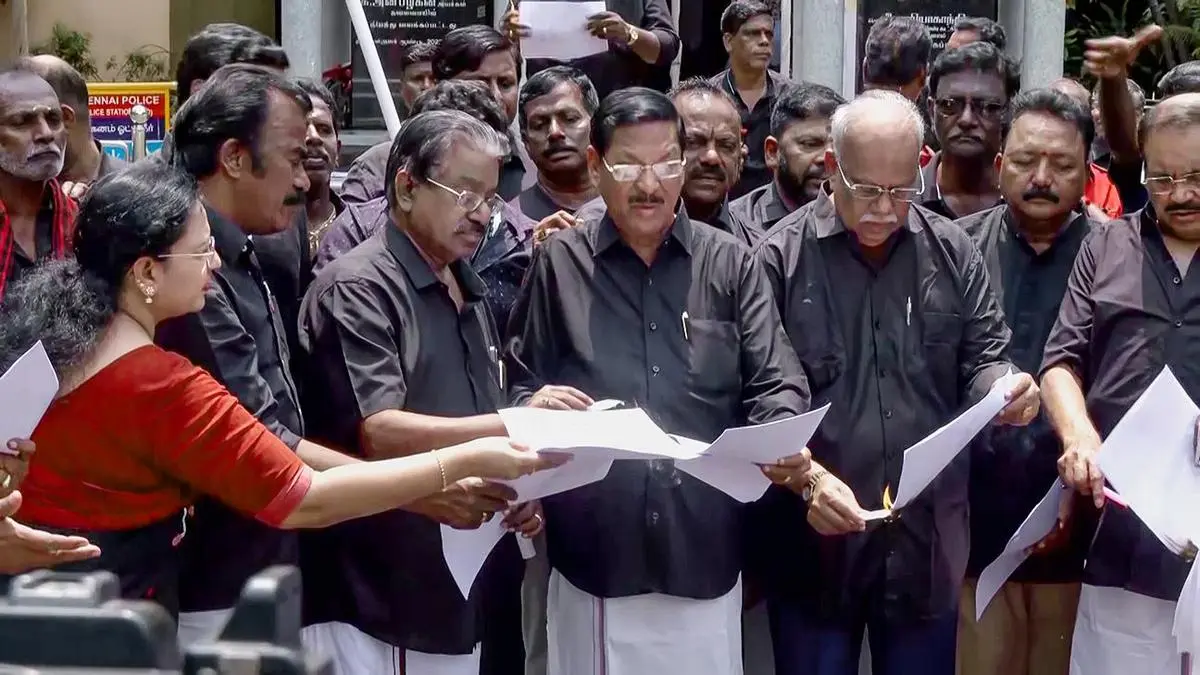
The DMK and its alliance partners stage a protest against the Constitution (131st Amendment) Bill, 2026, at the party’s headquarters, in Chennai, on April 16.
| Photo Credit:
ANI
It is being argued that delimitation is necessary—that it is an idea whose time has come, and that stalling it is in itself an anti-democratic act. How do you see that? Delimitation may well be necessary, but how should it be carried out?
Yes, you have framed it precisely. The first part is correct: delimitation is necessary. We have not carried out a full delimitation for almost 50 years, and something must be done about it. The democratic case for delimitation is that far too many voters currently elect just one representative, and in some States, far fewer people elect one representative than in others—there is a real asymmetry. This appears, on the surface, to be a straightforward democratic argument: If Kerala’s population entitles it to perhaps only 13 MPs in the Lok Sabha, so be it. I call it ‘so-called’ democratic, because a democratic argument about representation must also take into account the aspirations of the States. What I have been arguing—and many colleagues in political science, as well as political activists, have argued—is that any new approach to delimitation must combine the federal impulse with the plain majoritarian impulse of population size. This is also the main point I make with Sanjeer Alam in a position paper we wrote for the Pune International Centre some time ago.
That would require some kind of compromise and a long negotiation. No one has a clear formula; there are many possible approaches, but it is political parties that need to discuss them with one another. Earlier, one could argue that some southern parties were inflexible; but now, with the BJP’s position that population alone is the sacrosanct principle, negotiation has become even harder. With these two entrenched positions, I think at least another decade will be wasted before an agreeable solution to delimitation is found.
Could you take us back to 1976 and then to 2001, and explain the population-based argument? That is precisely why delimitation was postponed for 25 years. What was the assurance given to states that had stabilised their population? Population stabilisation was a national programme, and the southern states succeeded in it, while some northern states did not. What was that assurance, and how must it be kept in mind when designing the next delimitation?
In 1976, what occurred during the Emergency, and unfortunately, even then, there was not much dialogue. Let us be frank about that. When it happened in 1976, the ruling party’s idea was to freeze delimitation so as not to incentivise States with larger populations not to remain lax about population control. Personally, I do not think it was a very good idea to tie the discussion of delimitation exclusively to population control, because population fluctuates even in normal conditions. Even if 50 years from now, population growth stabilises across Indian States, migration would still occur— some States would have less population, some more.
Supporters of the BJP typically cite the example of the United States, where population-based representation in the House of Representatives has shifted over time. But we must remember that the fundamental asymmetry in India’s federal system is absent from the United States. Moreover, the US Senate gives all states equal representation, and it has a practical veto because it wields greater powers than the House of Representatives, whereas India’s Rajya Sabha does not enjoy even equal powers. A very substantial restructuring would be required if India were to follow that model. So 1976 happened by accident and by central fiat.
Over time, however, it became a conscious position among political parties: some States were successfully controlling population growth, others were not. Population growth is typically linked to the socio-educational progress of a population, and is therefore also related to the question of development—the socio-educational progress seen in a State like Kerala, as opposed to Rajasthan, Bihar or Uttar Pradesh. This draws attention to another asymmetry: the uneven development across India. Unless that is addressed, no truly agreeable delimitation is possible. When the next delimitation fell due under the 1976 amendment, the Vajpayee government decided in 2001, again by agreement, to postpone it by a further 25 years. One can ask why we should not simply postpone it again today. Fair enough.
But postponing such issues does not resolve them permanently. It would be better to introduce the federal dimension into the discussion of representation, because representation is not only about individual citizens but about groups of people, and therefore about States as well. Are we willing to give the Rajya Sabha equal powers? If we do, the Southern States and other developed States might agree. Or are we going to find another formula that gives weightage to population control? That might be another solution. For a long time, the consensus was that this is a volatile issue best left alone for now.
I want to ask about GDP-based political representation. Telangana Chief Minister Revanth Reddy has proposed it, and there is considerable discussion about it—including arguments that it runs counter to universal franchise. What are your thoughts?
As I said, I do not have a firm opinion on it. It looks attractive, but it does not really connect to representation as such. It might, in fact, be better to strike a separate deal: states that contribute more to the GDP receive more from the Centre in financial allocations. If you look at welfare expenditure today, the Union government pours in large amounts and then channels that money directly to state administrations for disbursement. That violates the federal principle. Instead, a less targeted block grant could be given to states to implement welfare programmes themselves.
So, financial resource allocation could be discussed separately as a kind of compromise formula — a way to persuade states to accept population-based representation. Giving direct GDP-based representation weightage might complicate things, because a state’s GDP share can slip for reasons beyond its control over time. After all, development is partly the ingenuity of a State’s people and partly the work of its government. People should not be penalised for poor representatives and poor governments. That is the slight problem with GDP-based representation.
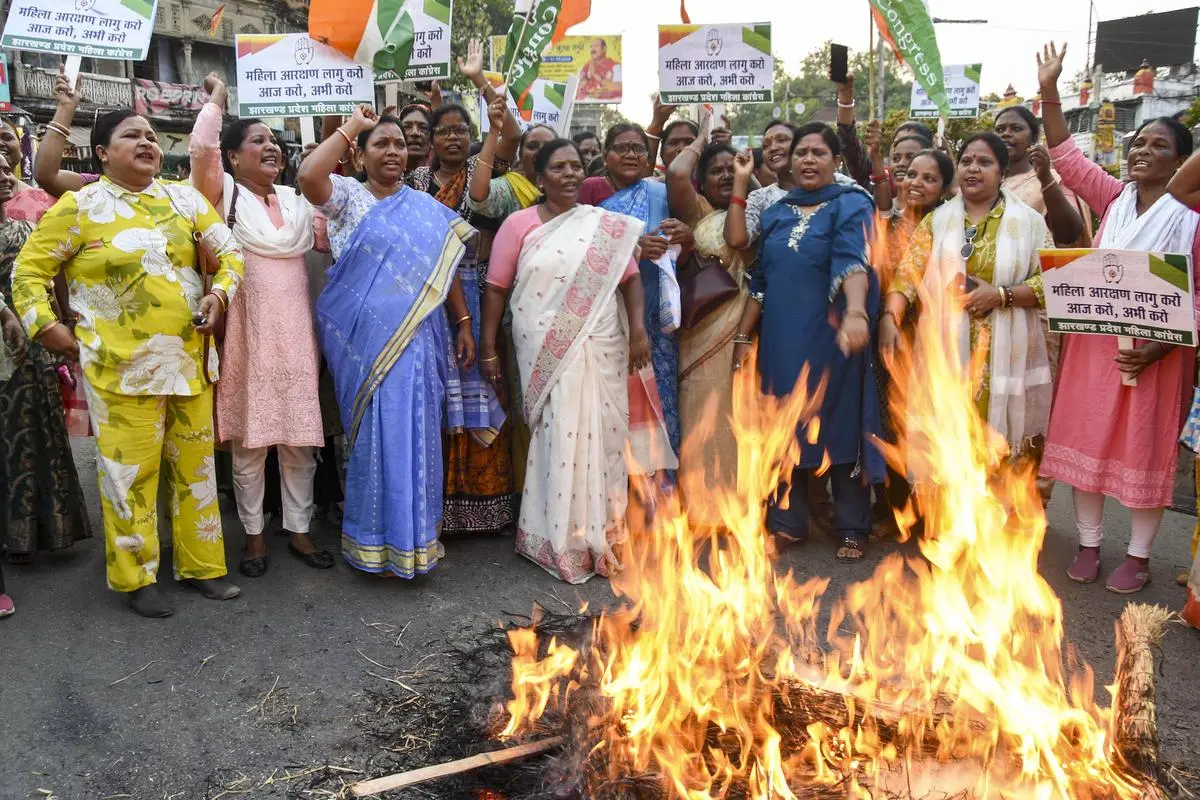
Jharkhand Pradesh Mahila Congress members protest over the Delimitation Bill, in Ranchi, on April 21, 2026.
| Photo Credit:
PTI
So in a way, you are suggesting that multiple ideas should be put on the table, that multiple groups—not just political parties—should be involved, and that broader consensus-building should drive the process.
Sorry to interrupt. Let me just remind our viewers that federal politics in India actually matured between 1990 and 2014—not because of any formal redesign of the federal structure, but because political parties recognised that give-and-take and coalition-building were central to governance. We are forgetting that today, and that is why we find ourselves in the current problem.
But I want to ask you this: we are forgetting it today at a time when the Central government is itself a coalition—dependent on a major southern State political party, and of course on Nitish Kumar in the north. Even in that situation, instead of choosing the path of consultation, the BJP has taken to the streets in confrontation mode, as we can see with the women’s reservation yatra across India. Why do you think that is? And relatedly, the BJP lost a vote for the first time in 12 years; do you think this is why they are unable to accept defeat and have taken to the streets?
Let me deal with the second question first, quickly. I suspect they knew these Bills would not pass. They wanted this opportunity to politicise the issue and corner the opposition—but that is a play for limited gains. The larger issue is what we started with: the ruling party’s imagination of what India is and how far it can push the nationalist agenda over the federal one. They believe the federal agenda is less important than nationalism as they define it. Similarly, they now argue that the apparent democratic impulse of population-based representation outweighs the federal impulse. This is an ideological position, not just political cleverness. They are not acting merely out of tactical calculation; they are acting out of conviction that India’s nationhood requires this kind of assertiveness.
You mentioned the weaponisation of women’s reservations. Many have argued that the issue of women’s reservation was being weaponised in order to push through the delimitation agenda. How is this weaponisation of major social and structural issues—using them to bulldoze an ideological or political agenda—going to impact a country like India?
One direct impact is that no political party would then have the maturity to overcome its own impulses and seek compromise. Once you have begun weaponising an issue, the temptation to weaponise becomes a common feature of politics—and that is bad for democracy, because you may be in power today, but another party may come to power tomorrow and do precisely the same thing. That is the core problem with weaponisation.
The other thing to consider is that this is about women today, but imagine if such weaponisation spreads to the South-North question—that flashpoint in our federation could erupt. Or consider the reverse: a movement in the north, in UP, Rajasthan or Bihar, demanding representation proportional to population share. Even parties like the Samajwadi Party and the Congress, which have bases in those states, would face tremendous pressure to embrace that position, because their voters would then be led to believe that the opposition is taking away their rightful representation. This is an extremely cynical use of partisan politics, and all political parties could find themselves on the brink of civil conflict rather than a negotiated settlement.
My last question is about civil society. We have seen how vilified civil society has been over the last decade. But this time, the pressure from civil society has worked significantly. Serious civil society organisations, banners and groups opposed this bill; they were ready to come out on the streets, and that pressure made a difference. How do you see this? Is it a good sign for democracy, given that majoritarian politics has been overriding almost everything in the last decade?
Three quick points. First, if civil society is active, that is always good for politics—you cannot leave politics only to politicians. Second, I am not entirely sure that civil society pressure alone was decisive. The configuration of party interests was such that this outcome was likely regardless. Civil society took a correct democratic position, and some alignment between party politics and civil society may now begin to emerge, which is not a bad thing. But third—and this is really important— that is precisely where the BJP has its real strength. They have the capacity not only to influence but to sweep civil society through their various, multi-pronged organisations.
In the competition for influence over civil society, autonomous civil society organisations are at a disadvantage compared to the sponsored or politically managed civil society of the ruling party. That is going to be the major issue in the years ahead: what kind of civil society do we have? Do we have a genuinely autonomous civil society—one that may support the DMK or the Congress today but tell them tomorrow that they are wrong? Or will we have a servile civil society, permanently tied ideologically to whichever party is in power? That is going to be the tough question.







Leave a Reply