
They would have gone unnoticed, like most of the working poor in urban India. But then the occasional exception happens. A flash strike by a sizeable section of gig and platform workers on December 25 and then on New Year’s Eve stirred up a storm over emoluments, payouts, low or non-existent incentives, and near-inhuman working conditions.
The debate was kick-started by none other than the CEO and founder of e-commerce platforms Zomato and Blinkit, who in a series of posts on X appeared flippant and dismissive of gig worker issues and indicated that claims of overwork, ten-minute delivery deadlines, and low payouts were exaggerated. He raised questions about the success of the strike, claiming that record deliveries were made despite the call, hinting that it was a failure. He thanked law enforcement agencies for their role in ensuring that deliveries were made despite efforts of some “miscreants”—alluding to striking gig workers. He defended gig work and its apparent benefits. Views and counter-views on the pros and cons of gig work flooded the media.
Unions claimed that nearly two lakh gig workers who worked as “delivery partners” struck work, though aggregators disputed the figure. The real issue, however, should not have been about the success or failure of the strike call but the issues raised about one of the most exploitative forms of work, where emoluments were linked to the number of deliveries made in a tight time frame over a day, irrespective of hostile weather conditions and traffic challenges. Apart from these, there was no concept of fixed wage, fixed working hours, guaranteed social security, employer-employee relationship, and insurance against accidents—common occurrences during such work.
For the urban consumer, enamoured with the idea of quick delivery and in the comfort of their living room, the gig worker is an invisible entity; the delivery men and women an icon of progress, of Viksit Bharat. Strangely, the Central government also believes in the benefits of the gig economy as a source of employment, especially e-commerce, irrespective of the impact it may have had on the closure of several retail stores, including the displacement of labour from small neighbourhood shops.
Political support
Even though a section of gig and platform workers struck work, the move received support from various central unions and political parties. Raghav Chadha, Rajya Sabha MP from the AAP, supported the gig workers’ strike and called for a ban on the ten-minute delivery system, “algorithmic punishment”, and ID blocks. To extend solidarity, he also worked as a delivery rider. Other parties who raised voices in support of gig worker rights included the CPI(M), Congress, and Trinamool Congress. In the last Budget Session, A.A. Rahim, CPI(M) MP, had flagged the issue of the exploitative nature of gig work in Parliament, urging for legislation that recognised delivery persons as “workers”. The Central government waited and watched.
Finally, a fortnight after the strike, the Union government woke up from its slumber and directed aggregators to do away with the ten-minute delivery schedule. That it took a flash strike to draw the government’s attention to one of the most inhuman aspects of gig work in the e-commerce sector was itself telling. The Indian Federation of App-based Transport Workers (IFAT) and the Telangana Gig and Platform Workers’ Union (TGPWU), who were behind the strike call, welcomed the Ministry’s intervention. They said that Blinkit had officially removed the ten-minute delivery promise from all its branding and platforms. It revised its main tagline from “10,000+ products delivered in 10 minutes” to “30,000+ products delivered at your doorstep.” The government held discussions with leading platform companies such as Swiggy, Blinkit, Zepto, and Zomato, urging them to do away with delivery time commitments.
Shaik Salauddin, national general secretary of IFAT and founder president of TGPWU, said that the intervention was a victory for all gig and platform workers, especially in the context of the nationwide flash strike and protests held from December 25 to 31 that drew attention to unsafe work practices imposed by platforms. The ten-minute delivery model forced delivery partners into dangerous road behaviour, extreme stress, and unsafe working conditions.
Central unions such as the Centre of Indian Trade Unions (CITU) congratulated the gig workers on their achievement but cautioned that the removal of the ten-minute deadline was only the tip of the iceberg. It said that the government’s claim that the end of the ten-minute delivery model would lead to ensuring “greater safety, security and improved working conditions for gig workers” was far from reality. Changing the ten-minute delivery model to a fifteen-minute one hardly made a difference to the exploitative structure on which gig work was based.
The CITU pointed out a continuous decline in the per-delivery rate on e-commerce platforms, which was one of the reasons for frequent strikes. The daily earnings of workers were milestone-based and dependent on distance-based incentive structures. Workers’ earnings continued to be a function of the number of deliveries per day and the distance travelled to complete them. Workers would be compelled to chase deliveries in order to meet basic livelihood requirements.
Also, none of the four labour codes notified by the government had recognised gig workers as workers. Neither did the codes address issues of algorithmic control over orders, ID blocking, minimum wages, working hours, and industrial relations in the sector.
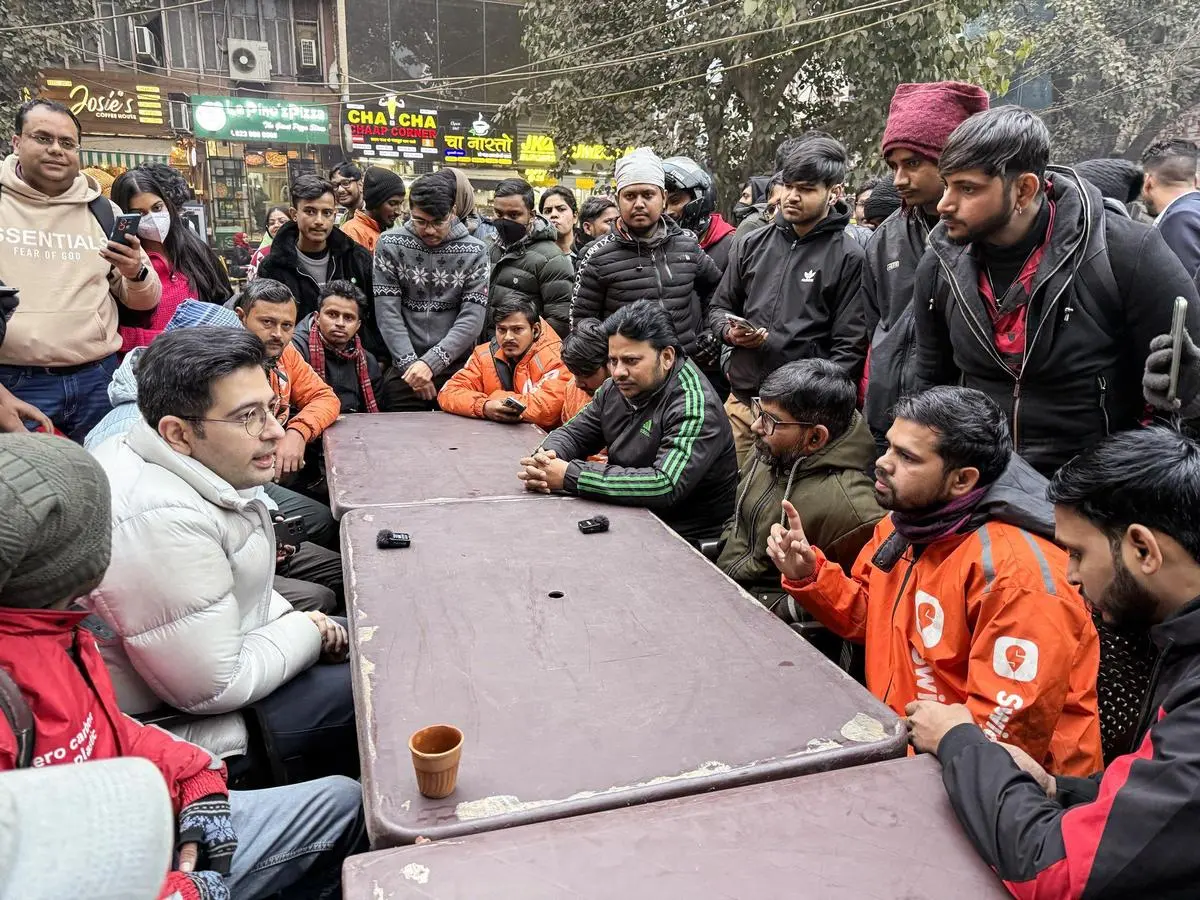
Aam Aadmi Party MP Raghav Chadha with gig workers at Old Rajinder Nagar, in New Delhi, on December 31, 2025. He called for a ban on the ten-minute delivery system, “algorithmic punishment”, and ID blocks.
| Photo Credit:
ANI
Salauddin agreed that there was clear evidence of ID blocking of gig workers by aggregator companies. He said that field studies in Hyderabad showed that 40-45 per cent of workers had experienced sudden deactivation of their IDs without any prior notice or reasons. Many workers also reported the absence of a grievance redressal mechanism.
In the absence of any stable forms of employment, gig work as an alternative has emerged in a big way. A 2022 NITI Aayog report, “India’s Booming Gig and Platform Economy: Perspectives and Recommendations on the Future of Work”, estimated there were around 68 lakh or 6.8 million gig workers in 2019-20, with half of them in retail trade and transportation. The report projected that the numbers would go up to 23.5 million by 2030.
Draft rules
Notwithstanding the rolling back of the ten-minute service delivery system, there is concern among the gig worker unions about the draft rules of the Code on Social Security, one of the four labour codes that were notified recently. It has been the claim of the Central government that it alone had, under its regime, provided platform and gig workers social security under the Social Security Code. The government views the gig and platform workforce as a “crucial driver of the new economic ecosystem, powered by young demographics, digital adoption and rapid urbanisation”. What it had conveniently chosen to ignore were the layers of overwork and exploitation behind such work.
The government takes credit for bringing gig workers formally under the ambit of labour laws. The various benefits include social security benefits such as life and disability cover, health and maternity benefits, pension, accident insurance, and creche services; a Central government-set-up facilitation centre to address grievances; a social security fund to be formed from contributions from aggregators; and a unique Aadhaar-linked ID on the e-shram portal that would make benefits portable across platforms. The enhanced provisions, the government claims, “equip gig and platform workers with essential safeguards, empower them with portable rights and transform informal work into a secure, recognised and sustainable livelihood”.
The problem is that the government itself views and defines the gig worker as someone who is outside the traditional employer-employee relationship, a definition that gig worker unions do not agree with. Similarly, platform work is defined by the government as a work arrangement that lies outside of a traditional employer-employee relationship, where an organisation or individuals use an online platform to access other organisations and individuals to provide specific services as may be notified by the government in exchange for payment.
Also Read | Pushing workers to the edge
Strangely, even as the government claims that it has formalised gig work by providing a social security cover, with the added responsibility of notifying what would constitute gig work, it does not deem it important that gig workers and aggregators should have a formal employer-employee relationship. Apart from defining what is gig work and platforms, the government’s involvement on the whole seems minuscule. The Code on Social Security provides for a Social Security Fund to be financed from a cess of 1-2 per cent of the annual turnover of aggregators. The fund would in turn finance a slew of social security schemes.
The catch
In the draft rules released recently, a gig or platform worker would be eligible for social security if she completed 90-120 days of work in a year. The unions say that social security cannot be linked to arbitrary day counts. “Eligibility must be universal and pro-rata, starting from the first day of work, based on hours logged or earnings, with platform contributions made for every active worker, even if they worked intermittently or across multiple apps. If platforms claim that delivery partners work only few weeks in a year, then the 90-120 day eligibility threshold makes the draft rules dead on arrival. It excludes the real workforce and protects only a tiny top layer—less than three per cent,” says Salauddin.
There were issues also with the classification of gig workers as they were defined as a separate category with little or no entitlement to minimum wages, job security, and collective bargaining. There was vagueness in designating the platform as an employer, which made them unaccountable for guaranteeing social security, compensation, and safety. While the rules mandated the registration of gig or platform workers for the purpose of social security, there was no such obligation on the aggregators to be registered as employers with the appropriate government. The Rules did not make it mandatory on platforms to provide social security; the welfare provisions depended on schemes and contributions, not enforceable rights, Salauddin pointed out.
While the Code provided for schemes of “life and disability cover, health and maternity benefits” for platform workers, there was no reference to it in the Rules. Neither were there any details in the Code on what were the schemes applicable to delivery workers and how they were supposed to access them. Neither was there any time-bound grievance redressal mechanism. There was unchecked algorithmic control and ratings, incentives, and deactivations of IDs were unregulated and opaque. Clear compliance mechanisms for platforms were absent in the Rules. Equally vague was the unspecified jurisdiction of the aggregator in terms of the relevant ministry and legislative Act applicable to the aggregator.
With overall weakened inspection systems built into the codes, even where formal employer-employee relationships existed, it was unlikely that violations by aggregators would be taken up seriously under the present labour law regime.
Ground realities
Twenty-something Satbir, a Blinkit rider in Ghaziabad, told Frontline that even though the delivery time had been increased by a few minutes following the December 2025 strike, the payout per 2.5 km had gone down from Rs.36 to Rs.31. “This means we have to do more rides in order to sustain previous levels of earnings. Only we know what we have to go through,” he said.
Monu, a rider with a food delivery aggregator, said that work starts at 6 am onwards and goes on until 4 pm. Even though the coverage area is 3 km, often the range extends to 5 km as well. “We work for 11 hours, spend Rs.200 on petrol. Earlier, we used to get 26-27 orders daily and earned up to Rs.1,000 a day but orders per rider have come down. There are too many now in this kind of work. Today I have got only 12 orders and made Rs.238 only,” he said. “The aggregators behave as if they own us. There is an area called Sainik Farms; some areas there are very isolated where there’s a danger of being attacked by wild animals. We are asked to deliver in such areas too,” he said. There were buildings with no lifts and riders had to then deliver heavy groceries weighing up to 10-20 kg as part of their work. On top of that, they had to tolerate the bad behaviour of customers as well.
History of strikes
Flash strikes by gig and platform workers, and even a few coordinated ones like the latest round, are becoming an increasingly common phenomenon. In summer 2025, Blinkit executives in Varanasi struck work demanding better payouts and working conditions. According to some databases, there were 15 strikes by Ola and Uber drivers between 2016 and 2018 over low pay, unfair practices, and lack of regulation. Many of these strikes were concentrated in the major metros.
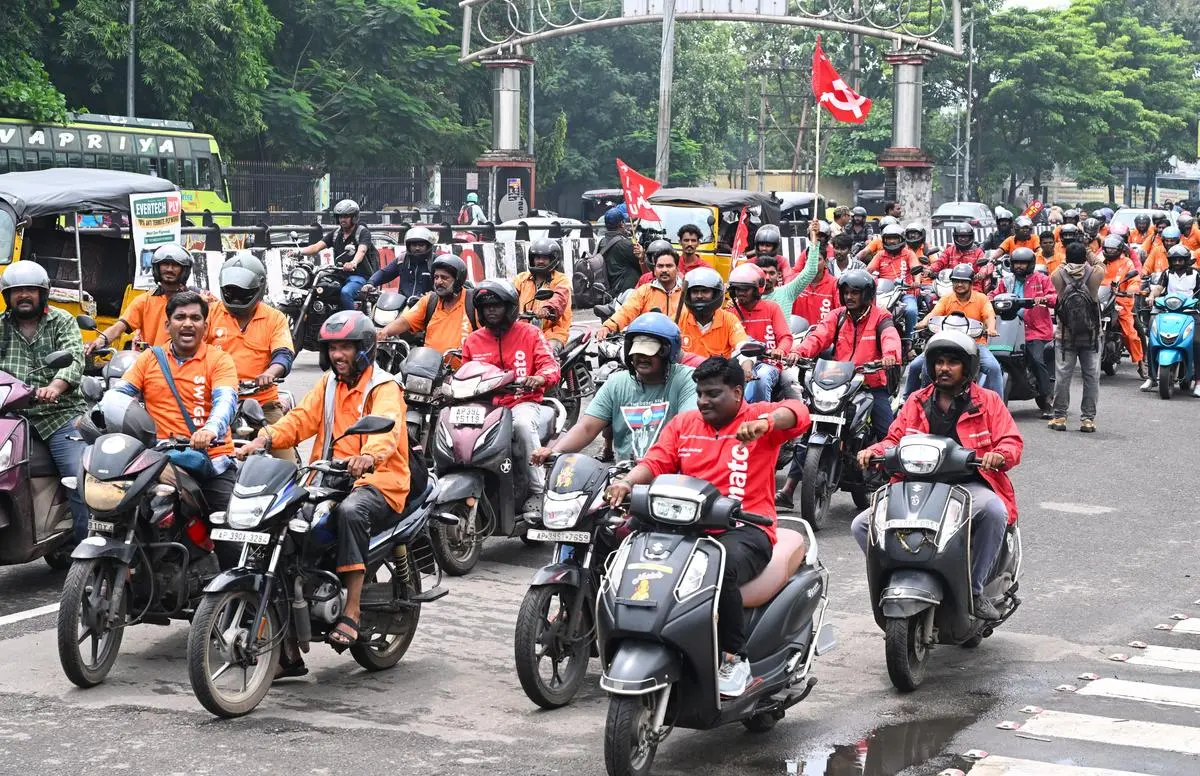
Members of the All India Gig Workers Union, affiliated to the CITU, taking out a rally demanding immediate reinstatement of gig workers, who they alleged were illegally terminated from services, among other demands, in Visakhapatnam, Andhra Pradesh, on September 9, 2025.
| Photo Credit:
V. RAJU
In May 2025, the Rajdhani App Workers’ Union, affiliated to the CITU, filed a complaint with Delhi’s labour department against Zepto and its third-party vendor, accusing them of exploitative practices under Zepto’s Rural Mobilisation Programme. Workers, the union claimed, were lured under the pretext of good wages, working conditions, and accommodation. Third-party vendors were neither aggregators nor workers and largely unregulated.
In July 2025, Ola, Uber, and Rapido drivers went on a three-day strike in Mumbai demanding better commissions, higher per-kilometre fares, and government intervention. The airport authority had to issue an advisory requesting passengers to make alternative travel arrangements.
State-level laws
A few States have enacted laws for gig workers but they are in various stages of implementation. Not all entitlements are statutorily backed in some of the laws. Most of the laws also lack minimum wage guarantees and rights to collective bargaining. The focus is more on social security, setting up of a welfare board/fund, mandatory registration, and a grievance redressal mechanism.
In 2023, the then Congress government in Rajasthan became the first to enact the Rajasthan Platform Based Gig Workers (Registration and Welfare) Act. It is yet to be implemented. Bihar enacted its own law in 2025 after major State-wide strikes in 2024-25; Karnataka enacted one in 2025 but is yet to notify it; Telangana has a draft Bill; Jharkhand’s law came last year, with features that provide for minimum wages and hefty penalties for violations by aggregator companies.
Also Read | Is this the end of worker power?
Some industry bodies such as National Association of Software and Service Companies (NASSCOM) raised concerns with Jharkhand’s law for gig workers over the provisions on minimum remuneration and apparent lack of industry representation on the welfare board. It was also pointed out that the law was not aligned with the Code on Social Security, 2020.
The concern is that even if there are laws for gig workers’ welfare, the central issue would always be enforceability by governments. With provisions in the labour codes that weaken collective bargaining and dilute inspection mechanisms, it is anybody’s guess as to how laws for gig workers will ultimately pan out.








Leave a Reply