
Why you can trust TechRadar
We spend hours testing every product or service we review, so you can be sure you’re buying the best. Find out more about how we test.
KitchenAid Semi-Automatic Espresso Machine two-minute review
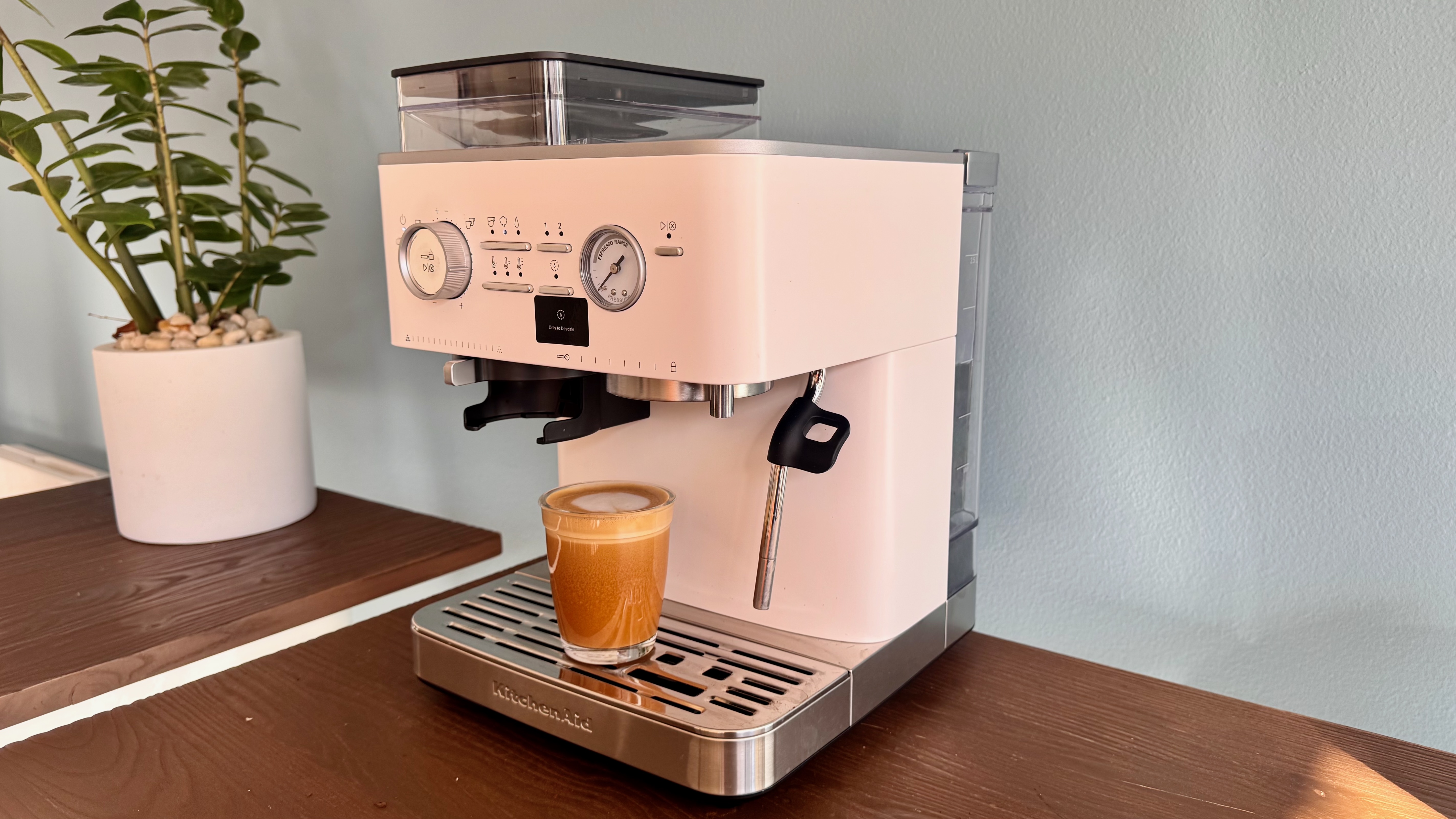
In a crowded market where there are so many fantastic coffee machines, the KitchenAid Semi-Automatic Espresso Machine stands out by being one of the better-looking options on the market. Not only does it look premium, but it feels it too. This machine is solidly built, and the supplied accessories including the removable bean hopper, porta filter and tamper, have a decent amount of weight to them, further adding to the overall premiumness of the machine.
It’s available in a range of colors, but I feel my review unit in Porcelain (white) will be the easiest to match with kitchen decor (although I have to admit taking a fancy to the Juniper green, too).
If you want to get hands-on with your coffee-making process, it makes the process easier by way of a flat-bottom porta filter that I think should become customary on all coffee machines of this type. This design choice is a stroke of genius, giving you a far greater ability to apply a good amount of tamping pressure, essential for extracting a good shot of espresso.
While it does have ‘semi-automatic’ in its name, this only really applies to the amount of coffee grounds it will dispense into the porta filter. You decide how much that is, the grind size and, if you want milk with your coffee, that’s a manual process too.
Figuring out the optimal settings for your personal taste will, therefore, require some trial and error, but if you’re considering buying a coffee machine like this one, that’s likely something you’ve already considered and are happy to get involved with.
Some assistance is given, such as an ideal window of pressure shown in a pressure gauge, so you’ll know if you’ve put the right amount of coffee and applied the right amount of pressure when tamping. Once you’ve completed these steps, the KitchenAid Semi-Auto produces a wonderful shot of espresso. Taking all of this into account, I consider it to be one of the best bean-to-cup coffee makers.
It’s not short of competition in terms of price and features, and there are other models that offer greater usability, such as smart tamping and dosing systems — the De’Longhi La Specialista Touch, for example. Despite that, I think it’s competitively priced and can regularly be found with a discount, which only adds to its value.

KitchenAid Semi Automatic Espresso Machine review: Price & availability
- Launched in 2024
- List price of $699.99 / £699 / AU$899
- Often available with a discount
The KitchenAid Semi-Automatic Espresso Machine launched worldwide a couple of years ago in 2024. It remains on sale today and more often than not, for the same price as when it launched. With a list price of $699.99 / £699 / AU$899, it’s fairly priced, but is arguably better value in Australia if you take direct currency conversions into account.
This KitchenAid machine is relatively light on features, offering just the basics of at-home coffee making, in the form of an integrated burr grinder, steam wand and hot water spout. In terms of price, it’s not short of competition, but some price-comparable alternatives offer more in the way of features.
These include the Breville Barista Express (Sage Barista Express in the UK) for $699.95 / £629 / AU$599, the Ninja Luxe Cafe with a price tag of $599.90 / £549.99 / AU$799.99 and the De’Longhi La Specialista Arte Evo costing $699.95 / £499 / AU$649. In Australia, it gains another competitor in the form of the Sunbeam Origins Sense, which is now regularly available for under AU$700.
All offer a built-in grinder, varying levels of customization and a built-in steam wand. The Ninja and De’Longhi machines are able to produce cold-brew coffee, for example, something not on the KitchenAid’s menu. The Ninja Cafe Luxe also takes care of the grinding and tamping process for you, offering a more hands-off approach.
However, at the time of writing, this KitchenAid machine is on the receiving end of discounts of up to 30% direct from the maker in the US, UK and Australia.
KitchenAid Semi Automatic Espresso Machine review: Specs
|
Name |
KitchenAid Semi Automatic Espresso Machine KES6551 |
|
Type |
Bean-to-cup |
|
Dimensions (H x W x D) |
15.6 x 13.2 x 11.1 inches / 39.5 x 33.5 x 28.1cm |
|
Weight |
23.6lbs / 10.7kg |
|
Water reservoir |
84.5 fl oz / 2.5 liters |
|
Milk frother |
Yes, built-in steam wand |
|
Bars of pressure |
15 – 18 |
|
User profiles |
None |
KitchenAid Semi Automatic Espresso Machine review: Design
- Flat-bottom porta filter is a revelation
- Attractive, retro looks in a range of colors
- Clear controls

The KitchenAid Semi-Automatic Espresso Machine is a relatively compact appliance with dimensions measuring 39.5 x 33.5 x 28.1cm (HWD), making it ideal for small kitchens or those who simply can’t spare the countertop space. At 23.6lbs / 10.7kg it’s quite a heavy unit, though, but its weight gives it added stability that prevents it from moving around when inserting and removing the porta filter.
KitchenAid is known for its chic color choices across its wider range of appliances and that’s the case here too. My review unit was the Porcelain (white) color with gloss finish, which is a standout for me, being easily matched with any kitchen decor. Other colors include Cast Iron Black, Candy Apple (red), Juniper and Stainless Steel.
This espresso machine is relatively light on button count, with the few available serving more than one purpose. The power button is on the left, while the start/stop button is on the opposite side. The middle is where most of the magic happens. The top left button will likely be used the most as it cycles through functions to pour the espresso shot, pour hot water and activate the steam wand.
There are also buttons to select a single or double shot, and to adjust the temperature of the water. Finally there’s a button to use when cleaning the machine.
The other main control is a silver dial that sets the dosage amount of coffee to be ground into the porta filter, and a lever to adjust the grind size. Pressing the central button begins dispensing the selected amount of coffee.
As with all coffee machines that require a hands-on approach, figuring out the grind size and grind amount for both single and double espresso is part of the fun, but requires plenty of trial and error. This is because the type of coffee beans you use will have an effect on the yield and, further to that, how they behave when being brewed. For example, a darker roast tends to perform better with a coarser setting than a medium roast due to the way it breaks apart when going through the grinder.
I used medium-dark roast coffee beans for this review and found turning the double shot dial to around 4 o’clock, and the grind setting to five lines from the right, yielded good results. While you can invest in scales to ensure you get the ideal amount — around 8g of ground coffee is often considered a good starting point for a single shot of espresso and 18g is considered optimal for a double — KitchenAid has added a small line in the porta filter baskets to indicate the ideal point where the coffee should line up once it’s been tamped.
You don’t want to go over this line, as doing so will create too much pressure during the brewing process, resulting in your coffee dripping out of the porta filter. A pressure gauge on the front of the machine shows an ideal window for a good espresso shot and, on a couple of occasions during my testing, the needle did go beyond it, resulting in the aforementioned drip pour.
Image 1 of 3


Speaking of the porta filter, I didn’t realize that a totally flat-bottomed one could be such a revelation! Every other porta filter I’ve used has two spouts protruding out the bottom; here, they’re integrated. This small design touch meant I could be a lot more confident when tamping, planting the porta filter firmly on a table and allowing me to apply force to pack the coffee grounds tightly enough. Porta filters with protruding spouts, however, require careful balancing when tamping.
This flat-bottomed porta filter is a commercial-size 58mm, and is satisfyingly weighty, which gave me added peace of mind that the KitchenAid machine has been made with care. The 58mm size has several benefits, including being used with a variety of tools and accessories — such as weighted tampers — to help achieve a well-extracted shot.
The 2.5L water tank at the rear of the machine features an integrated handle to help you remove it. This is one of the largest water tanks I’ve personally come across in a coffee machine, bigger than the Breville Oracle Jet’s (Sage in the UK) 2.3L tank. A water filter is supplied, which clips into a separate plastic handle. I had a little trouble at first getting the two pieces that hold the filter in place to clip together, despite following the instructions to leave the filter soaking in water for 5 minutes. I left it out of the water for a few days, after which it all clipped together as intended.

The KitchenAid Semi Automatic Espresso Machine also features an integrated steam wand with a silicone handle for safer handling, and a hot water spout. The steam wand is a traditional one, that meaning there’s no built-in thermometer like you’ll find on other machines such as the De’Longhi La Specialista Touch and Sunbeam Origins Sense, so you’ll need to rely on physical touch with the milk pitcher, or a use a separate food-grade thermometer, to determine when your milk is ready.
In the box is also a removable bean hopper, tamper (which is also well weighted), a 355ml milk pitcher (which does admittedly feel cheaper compared to the other accessories), single- and double-wall filter baskets in single- and double-shot sizes, and a cleaning brush.
A walnut wood accessory kit is available to buy separately for $249.99 / £229 / AU$349. This kit includes a bean hopper with a walnut-wood lid, and porta filter and tamper set with walnut-wood handles.
KitchenAid Semi Automatic Espresso Machine review: Performance
- Well-extracted espresso achievable after some experimentation
- Intuitive controls with visual aids
- Quick heat-up time
The KitchenAid Semi-Automatic Espresso Machine is a very capable machine, and will brew a well-extracted espresso shot with a good crema — it just requires a fair amount of trial and error to achieve it. Virtually all manual and semi-auto machines will need that little experimentation, though, so it’s by no means a dealbreaker. However, where some machines like the aforementioned De’Longhi or the Ninja Luxe Cafe will assist you in recommending the ideal grind and dosage settings, the KitchenAid leaves you to your own devices.
After loading your beans in the hopper on top of the machine — which fits up to 225g worth — you’ll need to adjust the dosage amount and grind size. If you’re brewing a single shot of espresso, you’ll move the front-mounted round to the left to adjust dosage, and to the right for a double (icons are on hand to signify this). A lever just below this dial will adjust the grind size, from coarse on the left to fine on the right. Note that the dial and lever have to be perfectly aligned with the graphic dots; if they’re not, the machine won’t operate.
You are able to personalize the amount of coffee grounds produced by pressing and holding the central button until it reaches the desired amount.

Once you’ve selected your settings, press the button integrated into the dosage dial to set the grinder in action. This KitchenAid machine, like the brand’s fully automatic models such as the KF8, is QuietMark certified, meaning it should be whisper quiet when the grinder is in motion. And sure enough, it is. The Philips LatteGo 4400 that I use daily is ‘SilentBrew’ certified but, in truth, I find it to be relatively noisy, and measured 69dB using the Decibel X app compared to 64dB registered by the KitchenAid when the grinder was in motion.
Once the grinder has finished, give the porta filter a little wiggle to help settle the ground coffee before removing it. This machine uses anti-static technology to help ensure nothing spills over the edge and it works like a dream, unlike the Sunbeam Origins Sense that dribbled some coffee during my testing despite claiming to also benefit from similar tech.
One of the key highlights of this machine is its flat-bottomed porta filter, which allows you to plant it on a flat surface to apply tamping pressure using the supplied tamper without disbalancing it. Once you’ve inserted and locked the porta filter in place for brewing — which is another simple and fuss-free process — use the buttons on the front of the machine to select a single or double shot, then set the water temperature to one of three settings. Finally, press the play/start button and your coffee will begin brewing.
Another key highlight of this machine is that it pre-infuses before brewing. This wets the coffee puck before full pressure hits it, which makes the water flow through the grounds more uniformly for better extraction.
If you’ve adjusted the dosage and grind settings correctly and provided enough tamping pressure, you’ll be rewarded with a beautiful shot of espresso with a lovely crema. It’s unlikely you’ll get the best settings on your first try (I certainly didn’t), so be prepared for some trial and error.
As with the grind settings, you can personalize the amount of water used for both single and double shots by pressing and holding the start/stop button until the desired espresso amount is reached in your cup. These water volume settings will be saved for future use. To reset to factory settings, press and hold the dose button for three seconds. All indicator lights will blink to indicate settings are restored.
However, the machine doesn’t have profiles, nor can it store different settings. If you have multiple coffee drinkers at home who prefer different beverage types, then you’ll need to manually set the grind and dosage amounts each time. If so, I’d recommend keeping a note of the optimum settings somewhere.

If you want to use the steam wand for milk foaming, you’ll first need to wait until the espresso has finished brewing as this machine doesn’t feature a dual boiler. Then press the button to switch from espresso to steam and wait a few seconds for the boiler to reheat. You’ll know when it’s done by way of a white LED on the left of the machine’s front panel. When it turns solid, you’re good to go. From here, press the same play/start button and steam will begin coming out of the wand.
As mentioned earlier, the steam wand here doesn’t have a built-in thermometer, so you’ll need to rely on touch to determine when the milk is done. I’ve had mixed results with ‘basic’ steam wands like this in the past, as some don’t provide enough pressure to effectively foam milk. That’s not the case here. I used both full-fat cow’s milk and oat milk during my testing and I was able to create a lovely textured foam each time. As with any steam wand, you need to angle it in the milk pitcher for the best results, but if you have the technique right, you’ll once again be rewarded with perfect milk.
The KitchenAid Semi-Automatic Espresso Machine has a descaling program to help keep it working at its best. You’ll know when it’s time, as a Clean Cycle light will blink. This didn’t happen during my testing, so I was unable to test the feature, but full instructions are provided in the user manual.
Should you buy the KitchenAid Semi Automatic Espresso Machine?
|
Attribute |
Notes |
Score |
|---|---|---|
|
Value |
Competitively priced, but some price-comparable models offer more in the way of features |
4 / 5 |
|
Design |
Gorgeous looks, premium accessories and a clear button layout make this an espresso machine you’ll want to show off |
5 / 5 |
|
Performance |
After a brief period of experimentation, you’ll be rewarded with beautiful espresso, and the steam wand produces perfectly foamed milk. |
5 / 5 |
Buy it if…
Don’t buy it if…
KitchenAid Semi Automatic Espresso Machine review: Also consider
KitchenAid Semi Automatic Espresso Machine review: How I tested
I tested the KitchenAid Semi-Automatic Espresso Machine over the course of a couple of weeks, using medium-dark roast coffee beans I picked up from my local supermarket. I’ve tested a few manual and semi-automatic coffee machines before, including the Sunbeam Origins Sense, so I was familiar with the process required for hands-on coffee making.
I had to experiment with the grind and dosage settings to find the ideal yield to ensure the espresso shots brewed with optimal results. I used the built-in steam wand to foam cow’s milk and oat milk, and found it produced excellent results with the correct technique.
Read more about how we test
First reviewed May 2026










Leave a Reply