
Operator confirms number of guests, crew in Bordeaux ‘displaying symptoms’ of gastrointestinal illness
The cruise operator, Ambassador Cruise Line, has just confirmed to the Guardian that “a number of guests and crew onboard Ambition have displayed or are displaying symptoms consistent with gastrointestinal illness” during their 14-night trip of western France and Spain.
A number of people have reported experiencing symptoms of a stomach bug following the ship’s departure from Liverpool, it said.
It is understood that the are currently 49 active cases of stomach bug among the passengers and the crew, just under 3% of the ship’s population.
The operator stressed that it takes the issue “extremely seriously,” with “enhanced sanitation and prevention protocols.”
The French health authorities “requested they conduct a routine review of the ship’s health status and records,” with samples sent for testing at the Bordeaux university hospital, with results requiring “a minimum of six hours to be processed.”
The gastrointestinal illness is not believed to be in any way linked to the separate hantavirus outbreak that dominated the headlines in the last week.
The testing is “ongoing,” with today’s planned activities on short cancelled with customers getting a full refund.
“Once clearance is granted, guests will be permitted to disembark,” the statement added.
Key events
Leaders brief press after Bucharest Nine meeting on security, Nato
As promised, you can watch along below, and I will bring you the key lines here.
As we are waiting for the press conference, we can quickly take a look at the summit’s joint statement, signed by the leaders of 14 allies in the central and eastern Europe, the Baltics, and the Nordics.
In particular, they said that Russia’s repeated airspace violations of countries on the eastern flank of Nato underline the urgent need to consolidate the alliance’s air defences against missiles and drones, Reuters reported.
Romania, Poland and Baltic states have had their airspace repeatedly breached by Russian drones. Russia has denied targeting Nato states.
“We condemn Russia’s highly confrontational actions against Allies and partners, including sabotage, cyber-attacks, and a wide range of hybrid attacks and destabilising activities,” the leaders’ joint statement also said.

Jakub Krupa
Back to international politics, we are expecting a press conference after the B9 meeting in Bucharest shortly, with Nato’s secretary general Mark Rutte expected among the speakers.
I will bring you the key lines here.
Meanwhile, Le Figaro reported that the French health authorities confirmed that “there is no reason to link this outbreak on board a cruise ship from Belfast and Liverpool with the hantavirus cases detected on the vessel MV Hondius,” as per the cruise ship operator’s statement earlier (13:47).
First photos of stranded cruise ship in Bordeaux
With passengers taking pictures of Bordeaux from the deck, as per our last update, let’s take a look at some pictures taken in the opposite direction…
No security measures were in place around the ship as it was docked in Bordeaux on Wednesday, an AFP reporter said.
Passengers were taking pictures of the French city from the deck.
Majority of passengers on board of cruise ship stuck in Bordeaux are British, operator confirms
Responding to the Guardian’s questions, the operator also confirmed that the vast majority of the 1,187 guests on board are British. There are also 514 crew members.
Ambassador Cruise Line also confirmed that a 92-year-old man died on board earlier this week, but he did not report any symptoms at the time and the cause of his death is yet to be established.
“We are providing every support to the deceased’s friends and family and extend our most sincere condolences to them at this difficult time,” it added.
Operator confirms number of guests, crew in Bordeaux ‘displaying symptoms’ of gastrointestinal illness
The cruise operator, Ambassador Cruise Line, has just confirmed to the Guardian that “a number of guests and crew onboard Ambition have displayed or are displaying symptoms consistent with gastrointestinal illness” during their 14-night trip of western France and Spain.
A number of people have reported experiencing symptoms of a stomach bug following the ship’s departure from Liverpool, it said.
It is understood that the are currently 49 active cases of stomach bug among the passengers and the crew, just under 3% of the ship’s population.
The operator stressed that it takes the issue “extremely seriously,” with “enhanced sanitation and prevention protocols.”
The French health authorities “requested they conduct a routine review of the ship’s health status and records,” with samples sent for testing at the Bordeaux university hospital, with results requiring “a minimum of six hours to be processed.”
The gastrointestinal illness is not believed to be in any way linked to the separate hantavirus outbreak that dominated the headlines in the last week.
The testing is “ongoing,” with today’s planned activities on short cancelled with customers getting a full refund.
“Once clearance is granted, guests will be permitted to disembark,” the statement added.
1,700 people reported confined on cruise ship in Bordeaux after suspected norovirus death
More than 1,700 people – 1,233 passengers and 514 crew members – are confined on a cruise ship docked in Bordeaux after a death of a 90-year-old passenger amid a reported gastroenteritis outbreak, AFP, Le Figaro and BMFTV reported.
Some fifty people have shown symptoms of norovirus, prompting the French health authorities to step in, it was reported.
The Ambassador Cruise Line ship, which left Shetland Islands and cruised via Belfast, Liverpool, Brest to Bordeaux and is scheduled to travel onwards to Spain, is reportedly carrying mostly British and Irish passengers, according to Le Figaro and AFP.
We will seek more information on this breaking news story.
Romania reeling over claims of high-level justice system corruption

Andrei Popoviciu
in Bucharest
Today’s Bucharest Nine talks in Romania take place against the backdrop of another domestic political crisis in the country, following the recent collapse of its pro-EU government.
But Andrei Popoviciu has also this great story on the country’s judiciary system in “deep crisis” six months after documentary exposed alleged network used to delay graft convictions.
As he says, “the cumulative toll is visible in the polls [as] a survey this year found that seven in 10 Romanians do not trust the justice system and more than half believe the law is not applied equally.”
“In recent years, a series of major corruption trials involving politicians and businessmen have collapsed after reaching the statute of limitations due to repeated delays in judicial proceedings and despite extensive evidence, including wiretaps of suspects appearing to admit wrongdoing.”
Read his story here:
Zelenskyy arrives in Romania to join B9 summit on security
The news of the attack comes just as Zelenskyy arrived in Romania, where he is expected to join the Bucharest Nine summit.
In a post on X, he said:
“The Bucharest Nine Summit is taking place here today, with the participation of Northern European countries. Important meetings are planned on the sidelines of the summit. All of us in the world need joint decisions and joint work so that there is more security for everyone.”
We will no doubt hear more on this from the B9 hosts, Romania’s Dan and Poland’s Nawrocki, and Nato’s Rutte at a press conference this afternoon.
Russia launches combined airstrike on critical facilities in Ukraine, hours after Zelenskyy’s warning, Ukraine says
Meanwhile, Ukraine’s military intelligence warned that Russia has launched “a combined … airstrike on critical facilities” in the country.
They said that the Russian army is sending “a significant number” of drones to overload Ukraine’s air defence systems, followed by air- and sea-based missiles and ballistic missiles.
The attack is reportedly targeting key infrastructure and support facilities of major cities, including energy facilities, defence industry enterprises, and government buildings.
This follows Zelenskyy’s earlier warning about a possible attack (9:57).
Israel goes through to Eurovision’s final despite boos, attempted disruptions
Elsewhere, it’s probably good to catch up on the results of the last night’s first Eurovision semi-final in Vienna, which saw Israel – at the centre of controversy and some boycotts of this year’s event – qualify for the grand final on Saturday.
Israel’s continued participation despite its military operations in Gaza led to a number of countries pulling out, led by Spain and the Netherlands, traditionally Eurovision’s fifth and sixth largest financial contributors, alongside Ireland, the joint record-holder with most winning contributions, Slovenia and Iceland.
Israel’s Noam Bettan’s performance of “Michelle” last night was marked with mixed reactions from the crowd, with some boos and chants of “Stop the genocide” audible in the TV broadcast.
Organisers reported later that some people were removed from the arena for “disruptive behaviour,” with another audience member ejected after allegedly seeking to “loudly express their views” close to the stage microphones and “continuing to disturb the audience.”
Among others who qualified to the final are one of the main favourites to win the contest, Finland’s Linda Lampenius and Pete Parkkonen, as well as representatives of Belgium, Croatia, Greece, Lithuania, Moldova (this blog’s favourites), Poland, Serbia and Sweden.
San Marino’s song, featuring British star Boy George, did not qualify.
A second semi-final, which will see another 10 go through, will take place on Thursday night, with the final – where they will be joined by the hosts, Austria, and the ‘big four’ of France, Germany, Italy and the UK – on Saturday night.
Russia’s aggression on Ukraine ‘not an isolated conflict,’ but Russia’s ‘direct challenge,’ Poland’s Nawrocki says
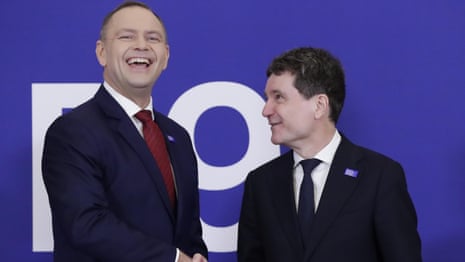
Opening the Bucharest Nine meeting this morning, Romania’s Nicușor Dan said the meeting was taking place in a “dynamic international situation,” pointing to the ongoing conflicts in Ukraine and the Middle East, and the threats experienced by surrounding countries, including Romania, but also Moldova.
Talking about Ukraine and Moldova, he stressed the continuing support for the two countries, adding that “we must not only make [it] declarative, but we must make it effective, because our security depends on their security.”
He also urged countries to increase defence spending and turn it into capabilities, developing a “solid transatlantic military industrial base” and confirming their commitment to act at the upcoming Nato summit in Ankara.
Poland’s president Karol Nawrocki said that when the format was first invented, “some believed that we were sounding the alarm too loudly.”
“We warned that Russia’s revisionism was not temporary; we warned that imperial thinking had returned to Europe, and that deterrence could not exist only on paper. Today, nobody can say they were not warned.”
He said that Russia’s continued aggression against Ukraine “is not an isolated conflict,” but rather “a direct challenge to the entire Euro-Atlantic security order.”
Our region is no longer Nato’s periphery; it is Nato’s strategic centre of gravity.
Nawrocki said that the Ankara summit will need to send a clear signal that “Nato is united, Nato is ready, and Nato will defend every inch of allied territory.”
“The Ankara summit must therefore strengthen Nato’s forward defence posture and demonstrate that the alliance possesses both the political will and the military capabilities necessary to deter aggression on every part of allied territory.”
Poland’s president ended with strong words of support for Ukraine:
“There should be no doubt as to who launched this brutal war. We must also remain fully aware of the role played by Belarus, which continues to support Russia’s war effort and enables hostile hybrid activities to be launched from its territory against Nato allies and partners.
We must collectively make sure that if a peace is to be reached just east of our borders, it has to be just.
The nations represented in this room understand, perhaps better than anyone, the cost of complacency. We know what happens when aggression is underestimated and when democratic nations hesitate.”
Ukraine’s Zelenskyy warns against Russian drones attack during day
Meanwhile, Ukraine’s president Volodymyr Zelenskyy warned of possible waves of Russian drone attacks throughout the day, saying that more than a hundred drones were in Ukraine’s airspace, as Moscow has shifted tactics to strike increasingly during daylight hour, Reuters reported.
“Russia continues its strikes and is doing so brazenly – deliberately targeting our railway infrastructure and civilian sites in our cities,” he said in a post on X.
He added:
“Unfortunately, people were wounded and killed in these strikes; my condolences to all their families and loved ones. Yesterday, 14 regions came under attack throughout the day. Overnight, strikes targeted residential and railway infrastructure in the Dnipro and Kharkiv regions, port infrastructure in the Odesa region, and energy facilities in the Poltava region. At all levels, our warriors are countering these attacks, and 111 drones were shot down or jammed overnight alone.”
Morning opening: What to do about Russia
Jakub Krupa
Russian foreign minister Sergei Lavrov said that despite some early positive signs about the US-Russia relations under Donald Trump, “nothing is happening” in reality as the peace process to end the war in Ukraine appears to be stuck.
Speaking to Russian media, Lavrov said that “good words” on potential cooperations with the US had brought no results so far as “nothing is happening in real life.”
“Aside from this regular dialogue – which is normal in relations between people and countries – everything else follows the pattern initiated by president Biden,” Lavrov said, pointing to sanctions against Russia in particular.
None of this will particularly worry the leaders of the Bucharest Nine, who meet in, well, Bucharest for their summit today.
The format, established in 2015, brings together the leaders of central eastern Europe and the Baltics with the leaders of Bulgaria, the Czech Republic, Estonia, Hungary, Latvia, Lithuania, Poland, Romania and Slovakia. This year, they will also be joined by some representatives of the Nordics.
Romania’s Nicușor Dan and Poland’s Karol Nawrocki are the hosts, and they will be joined by Nato’s secretary general Mark Rutte.
I will bring you all the key lines from their meeting, but it’s safe to assume that the questions of Russia, Ukraine and the broader regional security amid US moves to pull out troops from Europe will be high on the agenda.
It’s Wednesday, 13 May 2026, it’s Jakub Krupa here, and this is Europe Live.
Good morning.








Leave a Reply